"Newcomer" Arms Dealers Carve Up Military Procurement Pie
By Lu Shao-lung, China Times Opinion, January 13, 2026
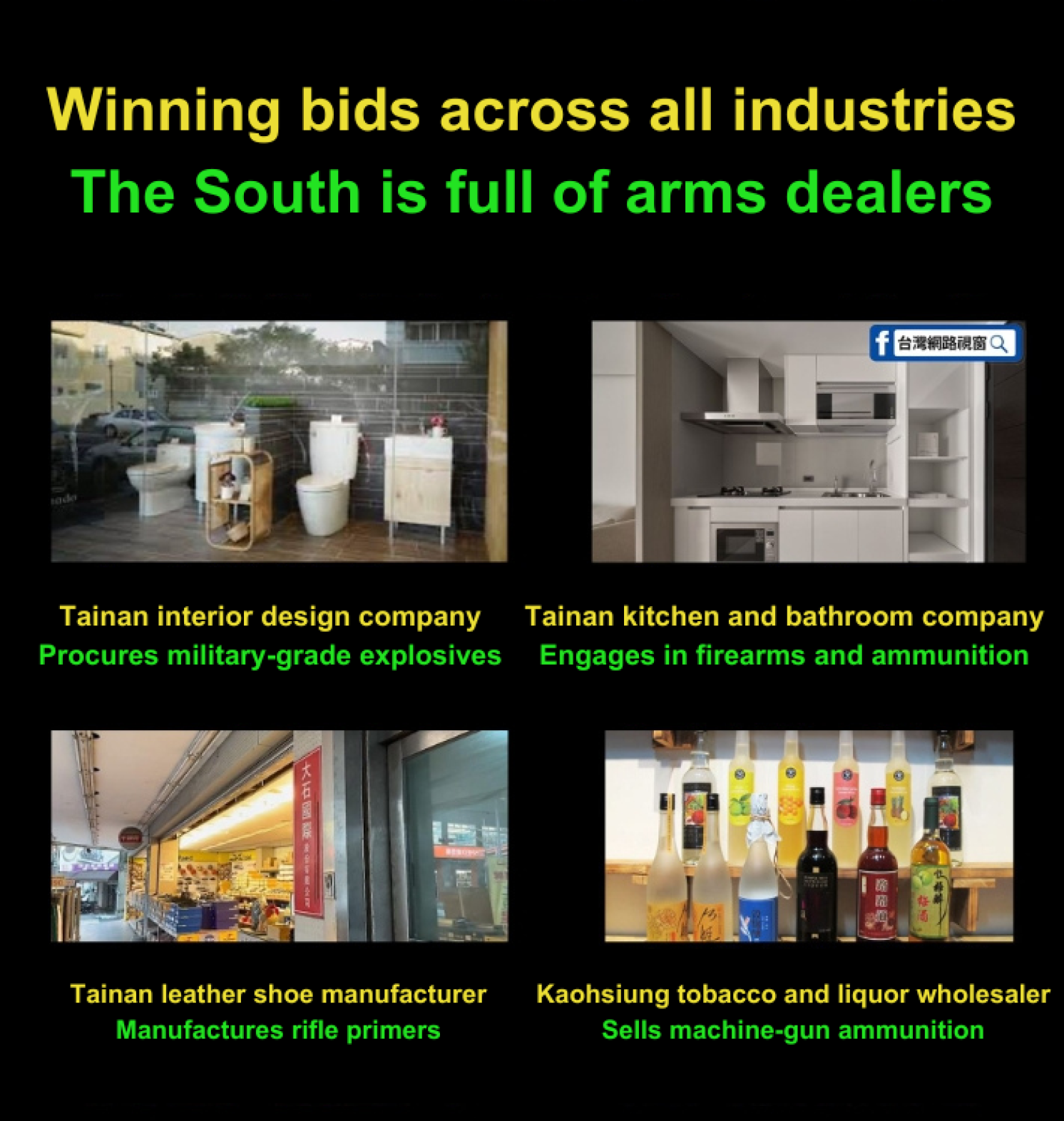
The Democratic Progressive Party (DPP) has been fully promoting the defense industry and has been in power for nearly ten years. From recent changes in arms-related business—such as interior decoration companies selling explosives, shoe manufacturers selling primers, and tea companies engaging in cybersecurity, all of them “newcomers” to the field—it is evident that the power structure of arms dealers is undergoing a reshuffle. As the saying goes, “when the world is in chaos, opportunities abound.” With cross-strait military tensions intensifying, the arms business environment is highly favorable.
Cases such as an interior decorator selling explosives and a shoemaker selling primers may seem unrelated, yet they share several striking coincidences. For instance, all were tenders from the 205th Plant of the Armaments Bureau, Ministry of National Defense (MND), and the registered locations of these arms dealers are all in Tainan City. Furthermore, their core businesses have nothing to do with munitions; they only modified their business registrations to obtain trading qualifications shortly before bidding, after which they successfully secured the contracts. As southern Taiwan is a DPP stronghold, the nexus between politics and business is complex—the string of solar power scandals being a prime example. Given that the 205th Plant is also located in southern Taiwan, it is no wonder the public suspects whether these arms deals involve illicit kickbacks or favoritism.
When asked about the unusual aspects of these tenders, Minister of National Defense Wellington Koo, in a rare show of anger, stated that as long as an entity possesses the qualifications to act as an international trade agent, can provide the relevant export qualification certificates, and passes verification by the MND, it is eligible to bid. He further emphasized that there has been no change in gunpowder procurement cases over the past two decades: bidders need only meet three qualifications—legal establishment certification, tax payment certification, and engagement in international trade. He countered by asking, “Does setting a certain level of registered capital make it easier for a company to fulfill contracts? Does focusing on a company’s name make it capable of performance?” The MND requires a 3-percent bid bond and a 5-percent performance bond in its contract design, and payment is made only after inspection and delivery. This, he said, is the true safeguard.
Minister Koo’s remarks conveyed two key points. First, as long as qualifications are met, anyone can become an arms dealer—effectively a declaration to break the existing arms dealer power structure. Second, although anyone can enter the arms business, payment is made only after passing MND inspections, making arms dealing a high-risk industry.
The collapse of Ching Fu Shipbuilding during the mine-hunting vessel procurement project, which led to the imprisonment of its principal, is a case in point. Engaging in arms deals requires not only strong connections but also substantial financial capacity, or backing from powerful financiers, because vendors receive payment only after meeting contractual milestones or completing delivery.
Before its collapse, Ching Fu maintained close political–business ties with the DPP. After securing the mine-hunting vessel contract, it obtained syndicated bank loans but misappropriated funds. When cash flow problems arose, it first pressured the Navy—through southern DPP legislators—to pay NT$2.4 billion (about US$75.8 million) in shipbuilding funds. When finances could not be resolved and it attempted the same tactic again, the military dared not comply. Ching Fu then sought mediation at the Office of the President after which audio recordings were exposed. The administration of former President Tsai Ing-wen required the military to shoulder responsibility and quickly terminate the contract with Ching Fu to clean up the situation. This was also a political calculation; as for whether it affected defense force-building, the DPP did not care.
The Ching Fu case illustrates that while anyone can become an arms dealer, not everyone ultimately succeeds. Even with strong political–business ties, risks remain. The DPP has been in power for nearly ten years, and together with the eight years of under President Chen Shui-bian from 2000 to 2008, the DPP has governed for nearly 18 of the past quarter century. The rise of pro-DPP arms dealer forces can thus be seen as a broader trend.
There is a saying in the arms industry: “Ten years without a deal, one deal feeds you for ten years.” That interior decorators and shoe manufacturers can transform overnight into arms dealers is a vivid illustration. Whether they can truly secure a meaningful share of the arms business, however, depends on delivering on time and to specification.
From: https://www.chinatimes.com/opinion/20260113004387-262104?chdtv